
How BYOB and VR Escape Rooms Foster Team Building and Communication
A practical guide for Austin teams at Zero Latency VR – South Austin
Ready to Build Your Team Through VR?
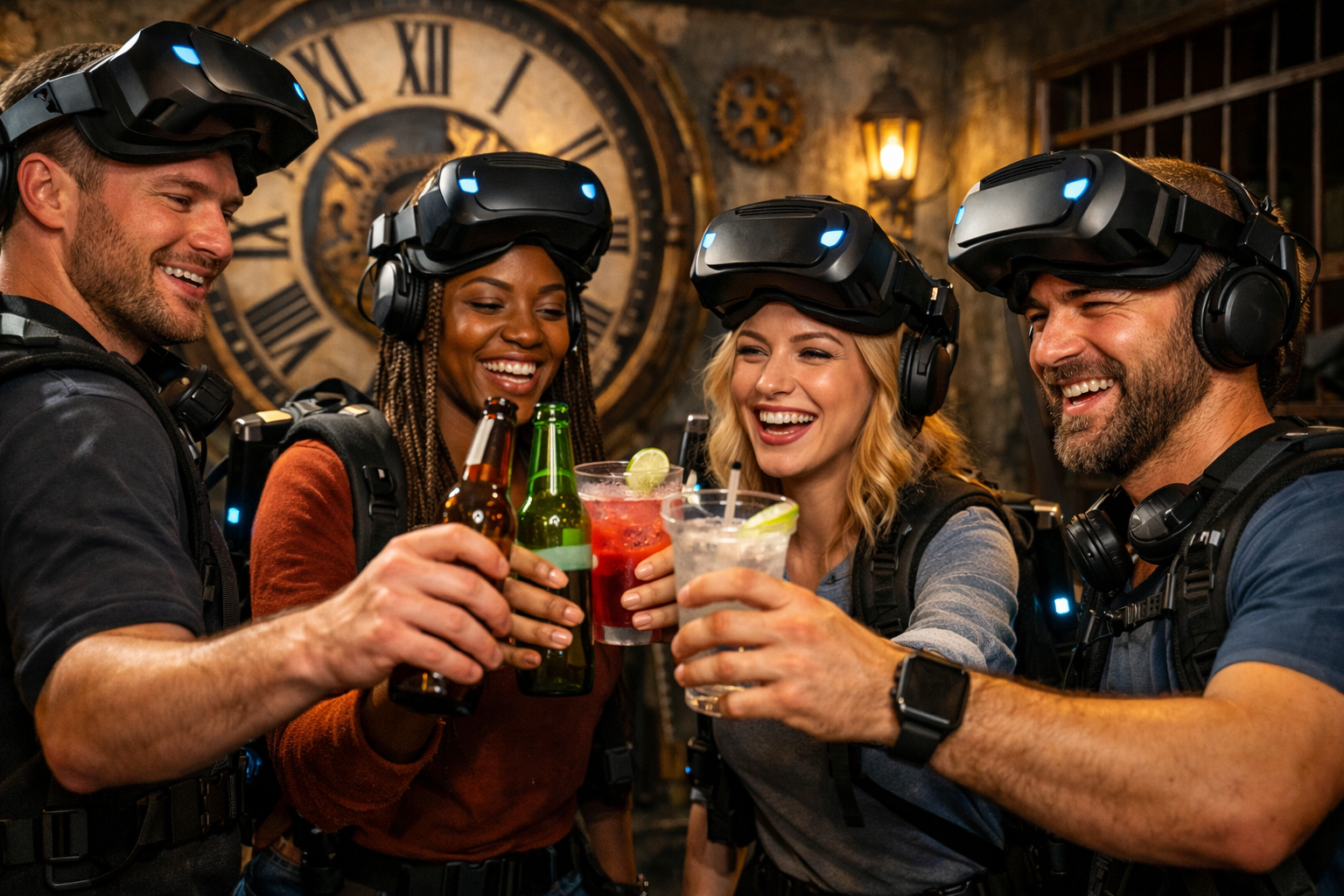
Most team building fails for one simple reason: it asks people to "bond" without giving them a shared mission. VR escape rooms solve that by putting your group inside a story where communication has immediate consequences—every clue callout, every handoff, every "I've got it" matters. Add BYOB (beer and wine) and you get something even more powerful: a relaxed social ritual that lowers the stakes just enough for people to talk, laugh, and collaborate like they do outside of work.
What you'll get out of this article
Why shared "low-pressure" social rituals (like BYOB) improve participation and openness
How VR escape rooms create real-time communication loops and role clarity
A simple facilitation plan (before, during, after) to turn fun into real team growth
Practical tips for managers and team leads—without turning the event into work
Responsible BYOB guidelines so everyone stays safe and included
1) Why BYOB helps teams connect faster
Team chemistry isn't built by forcing vulnerability; it's built when people feel comfortable enough to participate. In a work setting, many people self-edit—especially newer hires, quieter personalities, or anyone worried about looking "wrong." A BYOB environment can soften that edge by creating a familiar social context: people mingle, share recommendations, and settle in.
The point isn't "drink to have fun." The point is that a light social ritual—like bringing your own beverage and sharing it with friends—helps people transition from "coworker mode" into something more natural. It sends a signal: we're here to connect, not to perform.
Inclusivity tip: treat BYOB as "bring what you like," including non-alcoholic options. Mocktails, sparkling waters, and NA beers keep the vibe social without pressuring anyone.
2) How VR escape rooms create better communication than traditional team building
VR escape rooms are built around constraints: limited time, limited information, and a constant stream of decisions. Those constraints do something that typical team activities don't—they force communication to become a skill, not a suggestion.
In a VR escape room, your team has to:
- Share information quickly ("I found a key symbol with three dots!")
- Coordinate actions ("You rotate the valve while I hold the lever.")
- Manage attention ("We're stuck—let's regroup and share what we know.")
The puzzle provides structure. The VR provides immersion. Your team's job is to bridge the gap with words. In that sense, escape rooms are like workplace projects shrunk into 30 minutes—complexity, time pressure, and the need to align multiple perspectives.
3) The hidden superpower: psychological safety without the corporate vibe
Teams communicate best when people feel safe to speak up—especially with incomplete ideas. In organizational research, this is often described as "psychological safety." A playful challenge like a VR escape room creates a low-stakes environment where it's normal to guess, test, fail, and try again.
If you want to dive deeper into the concept, here are a few accessible starting points: Google re:Work on psychological safety ; Harvard Business Review overview .
In a VR escape room, "mistakes" are expected. Someone misreads a symbol, another person tries the wrong combination, and the team laughs, resets, and keeps moving. That cycle trains a healthier group reflex: problems are shared, not hidden.
4) Why BYOB + VR escape rooms work better together
On their own, BYOB creates social ease. On their own, VR escape rooms create communication pressure. Together, they create a balanced experience: relaxed enough for people to engage, structured enough to require teamwork.
Here's what we typically see with groups that combine the two:
Faster rapport: the pre-game hangout gives people a chance to connect casually.
More voices in the room: relaxed teams share observations sooner.
Better conflict handling: when tension does appear (puzzle stress is real), the social warmth from the pre-game moment softens it.
Stronger memory: teams remember the night—not just the game—because the whole arc feels meaningful.
5) The four communication roles that naturally emerge (and why they matter)
One reason escape rooms are useful for team building is that roles appear organically—without anyone assigning them. You'll usually see a mix of these four patterns:
The Spotter
Notices details, scans the environment, calls out clues, and keeps the team aware of what's available.
The Solver
Enjoys logic puzzles and pattern recognition, connects clues, and proposes solution paths.
The Coordinator
Tracks time, organizes tasks, makes sure people aren't duplicating effort, and keeps the team aligned.
The Builder/Doer
Executes actions—manipulates objects, tests solutions, and keeps momentum moving forward.
In a healthy team, these roles rotate. A strong facilitator encourages that rotation by inviting quieter people to take a turn as Spotter or Coordinator, and by reminding the Solver to narrate their thinking out loud.
6) A simple facilitation plan for maximum team-building impact
Before you arrive: set the tone (2 minutes)
Send a short message to the team that frames the event as a shared mission, not a performance. Example: "Tonight is about having fun and learning how we communicate under pressure. Try things, talk out loud, and help each other."
At the venue: warm up with BYOB (15–25 minutes)
Keep it light. Give people time to arrive, pour a drink (or grab a non-alcoholic option), and chat. If you want a quick structure, use a single prompt people can answer casually:
"What's one thing you're excited about outside of work right now?"
Avoid anything that feels like a forced icebreaker. The goal is comfort, not confession.
During the game: encourage "narration"
The #1 behavior that improves escape-room performance is narration: saying what you see and what you're trying. Simple phrases that help:
- "I'm checking the left room."
- "I found a symbol: triangle + wave."
- "I'm stuck—can someone take this puzzle?"
If your team is new to escape rooms, remind them once: "Talk out loud and share everything." Then let the game do the work.
After the game: debrief without making it weird (8–12 minutes)
Right after the experience, do a quick debrief while the energy is high. Keep it to three questions:
- What was one moment we communicated really well?
- What was one moment we got stuck—and what would we do differently next time?
- Who did something helpful that we should shout out?
That's enough to turn the event into real learning without dragging it into "meeting mode."
7) What teams practice in VR (that translates to the workplace)
Clear callouts: People get better at describing what they see in a way others can act on.
Closed-loop communication: Teams start confirming messages: "Copy that," "Do you mean the red lever?" "Yes."
Asking for help early: The environment normalizes help-seeking, which prevents silent struggling at work.
Role flexibility: People step into coordination or execution roles when needed instead of waiting for permission.
Calm under pressure: Time limits create stress in a safe space, giving teams practice staying composed and solution-focused.
If you're curious about closed-loop communication as a teamwork tool, this TeamSTEPPS overview from AHRQ is a solid introduction.
8) Responsible BYOB: keep it fun, safe, and inclusive
BYOB works best when it's simple and respectful. A few ground rules keep everyone comfortable:
Make it optional: BYOB is never a requirement to participate.
Include NA options: plan for non-alcoholic drinks so nobody feels singled out.
Keep it moderate: the goal is connection and teamwork, not a party that derails the game.
Eat beforehand: a light meal or snacks help everyone feel better.
Zero Latency VR – South Austin's BYOB policy and FAQs (including beer and wine guidelines) can be reviewed here: Zero Latency South Austin FAQ
9) Sample team-building itinerary (90 minutes)
Use this as a plug-and-play plan for a small team outing:
| Time | What you do |
|---|---|
| 0:00–0:20 | Arrive + BYOB social warm-up (or mocktails/NA drinks). |
| 0:20–0:30 | Quick orientation + headset briefing. |
| 0:30–1:10 | VR escape room experience (communication on, phones away). |
| 1:10–1:20 | Team photo + post-game high fives. |
| 1:20–1:30 | Mini debrief: 3 questions (what went well, what got stuck, shoutouts). |
10) Tips for getting the best teamwork experience
Aim for a manageable group size. Smaller teams usually communicate more clearly than giant groups.
Encourage one conversation at a time. If three people talk over each other, the team misses clues.
Rotate who leads a puzzle. If one person takes over, you lose the team-building benefit.
Celebrate process, not just winning. Praise clear communication, not only completion time.
End with food nearby. Post-game dinner or snacks in South Austin helps the shared story stick.
Explore our VR escape rooms and story-driven adventures here: VR Escape Rooms at Zero Latency South Austin .
Bonus: want a different kind of teamwork challenge?
If your team enjoys hands-on skill games, our sister brand also offers projector target axe throwing for groups. It's a totally different vibe—more physical, more "cheer for your teammate," and still great for team bonding.
FAQ
Do VR escape rooms work for mixed experience levels?
Yes. Great escape room design gives everyone something to do—spotting clues, moving objects, tracking progress, or solving puzzles. The key is encouraging narration so information doesn't get trapped in one person's headset.
What if someone gets motion sickness?
Many VR escape rooms are comfortable because you physically walk in the real space instead of using artificial joystick movement. If someone is sensitive, take breaks, stay hydrated, and let staff know—teams can adapt roles.
Is BYOB required?
No. BYOB is optional. Teams can enjoy the same experience with mocktails or non-alcoholic drinks.
How do we make sure it feels like fun—not another work obligation?
Keep the framing simple: a shared mission and a good time. If you do a debrief, keep it short, positive, and focused on communication wins.
Bring your team, bring your voice
The best teams aren't the ones with the smartest individuals—they're the ones who share information fast, stay calm when things get messy, and support each other through uncertainty. BYOB helps people relax into the experience. VR escape rooms demand communication and coordination. Together, they create a night your team actually talks about afterward—and a set of communication habits you can carry back into work.
If you're planning a company outing in Austin and want something that actually builds your team—not just checks a box—this is a great starting point.
Ready to build real team chemistry?
Learn more or book your session at Zero Latency VR – South Austin.