
The Family Night Upgrade: Why Free-Roam VR Works for Parents, Teens, and Mixed-Age Groups in Austin
A guide to family activities in Austin that actually work for everyone in the group
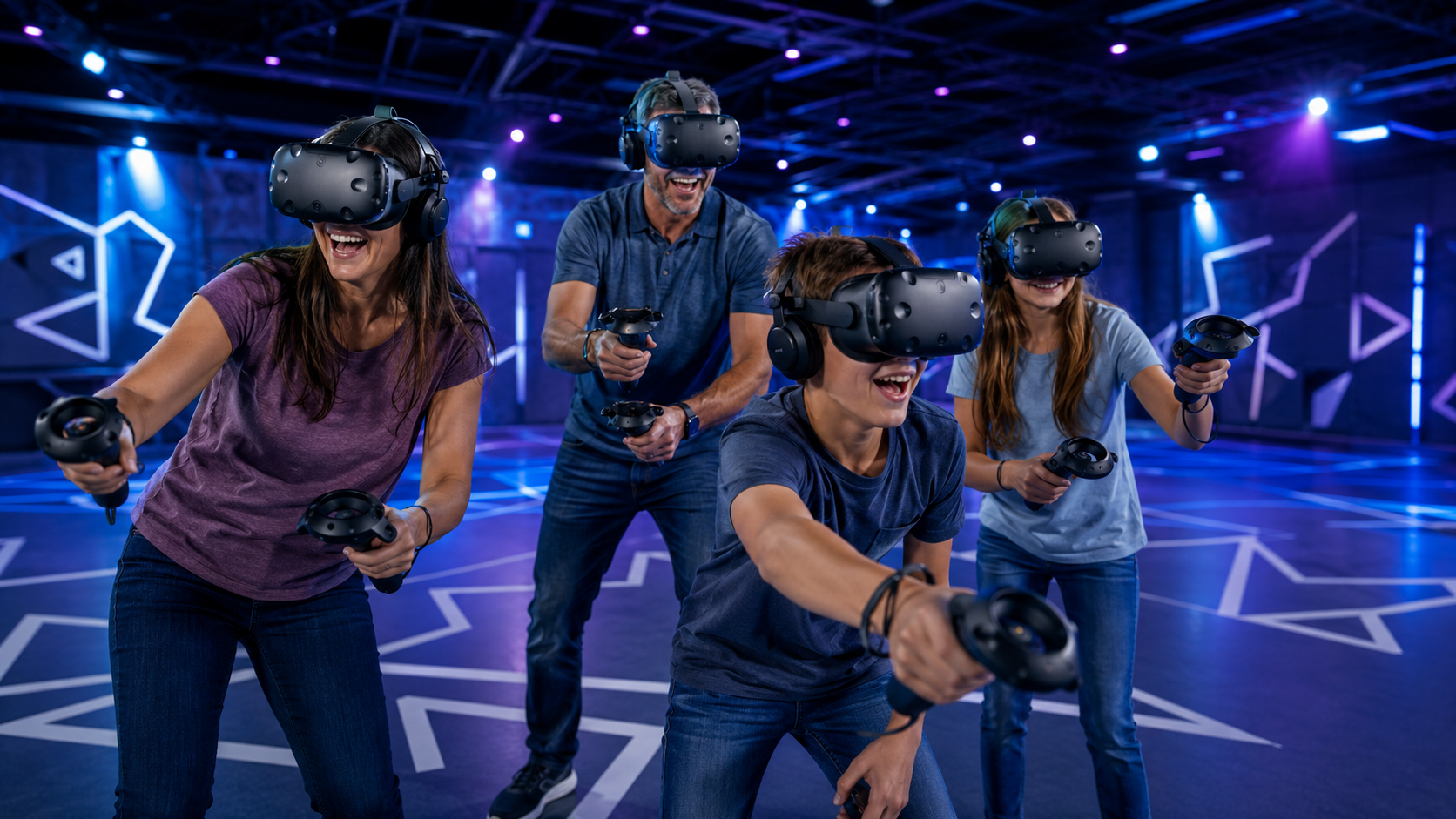
Austin has no shortage of places to go. That is part of what makes planning a family night out surprisingly hard. There are restaurants, movie theaters, parks, trails, arcades, live events, and the usual rotation of errands disguised as outings. But when the group includes parents, teens, adult siblings, cousins, visiting relatives, or a mix of people who all have different energy levels, the question changes.
It is no longer just, "What is there to do in Austin?" It becomes, "What is there to do that everyone will actually enjoy?"
That second question is the important one. A plan can look good on paper and still leave half the group scrolling on their phones. A dinner can be nice but predictable. A movie can be easy but passive. A normal arcade can split everyone into separate corners. Even a great outdoor plan can fall apart when Austin heat, rain, allergies, traffic, or timing gets in the way.
That is where free-roam virtual reality has become one of the most useful family activity ideas in Austin. At Zero Latency VR South Austin, players step into a shared virtual world, move through the arena together, communicate as a group, and walk out with a story they can keep talking about after the headsets come off.
The real challenge: finding an activity that works for everyone
Family outings are not hard because Austin lacks options. They are hard because most options only work well for part of the group. Young kids may want something loud and active. Teens may want something that feels current and not childish. Parents may want something that feels worth the time and money. Grandparents or visiting relatives may want to be included without feeling overwhelmed.
That is a lot for one outing to handle. The best family activities create a shared focus. They give the group a reason to talk, laugh, compete, help each other, and remember the same moment from different perspectives. That is why escape rooms, bowling nights, mini golf, and game-night restaurants can work so well — they give everyone a role.
Free-roam VR takes that idea and makes it bigger. Instead of gathering around a board, lane, or table, the group enters the same digital environment. The experience creates roles naturally, without needing anyone to plan them in advance.
Why free-roam VR feels different from a normal video game
The phrase "virtual reality" can make some people imagine a person standing alone in a living room with a headset on. Free-roam VR is a different category. In a free-roam arena, players are not sitting on a couch, staring at a television, or taking turns with a controller. They are physically moving through the space while the headset places them inside a virtual world.
That physical movement matters. The body is involved. Players turn, walk, aim, duck, communicate, react, and make decisions together. The game is digital, but the social experience is real. You hear your group. You see your teammates represented in the world. You have a shared objective. You are not watching a story happen to someone else. You are standing inside it.
For a clearer explanation of the format, Zero Latency VR South Austin has a simple overview of how free-roam VR works. The short version: free-roam VR gives players room to move through a virtual environment together, without the usual living-room limitations of stationary VR.
For parents
A chance to play alongside the family instead of watching from the sidelines. The experience changes the usual dynamic.
For teens
Feels current, not forced. The technology is interesting, the mission creates pressure, and the headset pulls attention in.
For mixed groups
Solves the challenge of different ages and energy levels by giving everyone the same world to react to together.
That is also why it works as a family activity even for people who do not normally think of themselves as gamers. The learning curve is less about being a gamer and more about being willing to participate.
Why teens are hard to impress — and why VR can still get through
Teens are one of the hardest audiences for family activities because they can spot a forced plan immediately. If the activity feels too childish, they check out. If it feels too slow, they get bored. If it feels like something parents chose only because it was "family friendly," they may show up physically while mentally disappearing into their phones.
Free-roam VR has an advantage because it does not feel like a lecture, a compromise, or an activity designed only for kids. It feels like an experience. The technology is interesting, the arena feels different from normal daily life, and the games create enough pressure and novelty to pull attention into the moment.
The key insight: Free-roam VR does not need to be framed as "family bonding time." It can simply be framed as, "We are trying something new." The bonding happens inside the experience because everyone is communicating, making decisions, and reacting to the same world.
There is also a subtle benefit for parents: VR gives teens something to react to without requiring them to perform enthusiasm before the activity starts. They can be skeptical, put on the headset, and still get pulled in once the mission begins. The activity does the convincing.
Why parents can enjoy it too
A lot of family entertainment is built around parents watching their kids have fun. That can be worthwhile, but it is not the same as shared participation. Parents deserve outings where they are not just supervising, paying, taking photos, or waiting nearby.
Free-roam VR gives parents permission to play without feeling silly. The headset changes the environment. The mission gives everyone a reason to focus. The group format removes the awkwardness of being the only adult participating. Parents can laugh, strategize, panic, celebrate, and compete right alongside everyone else.
That shift is powerful. Kids and teens are used to parents being in charge of logistics. Inside the VR experience, the family dynamic can loosen. A parent might need help from a teenager who figures out the game quickly. A teen might see a parent unexpectedly thrive under pressure. Siblings may have to cooperate instead of arguing.
Families may forget the exact restaurant or what everyone ordered. They are much more likely to remember the moment Dad got surrounded, the way a sibling yelled directions, or the time a normally quiet cousin carried the team through the mission.
A better kind of "screen time" conversation
Families talk a lot about screen time, and for good reason. Phones, tablets, streaming, social media, and games can fill every empty space if nobody is intentional about it. But the answer is not always to treat every digital experience the same. A passive hour spent scrolling alone is different from an interactive experience where a family moves, talks, works together, and shares a story in person.
The American Academy of Pediatrics encourages families to think about media use in terms of balance, context, and family values through tools like the Family Media Plan. Free-roam VR is still technology, but it is technology used in a shared, active, social setting. It can become part of a healthier rhythm when it replaces isolated scrolling or another passive entertainment night.
Everyone is wearing a headset, but the experience is not solitary. Players are talking, moving, reacting, and solving problems together. The headset becomes less like a wall and more like a doorway into a shared activity. The goal is not to pretend VR is "screen-free." It is to choose a type of technology that creates a real-world memory instead of another hour that disappears into a feed.
Movement without making it feel like exercise
Another reason free-roam VR works for families is that it gets people moving without turning the outing into a workout. Not every family wants to frame a night out around fitness. Not every teen wants to be told they need more activity. Not every adult wants to spend precious free time doing something that sounds like a chore.
VR sidesteps that resistance. The movement is built into the fun. Players walk because the mission requires it. They turn because something is happening behind them. They communicate because the team needs information.
Worth noting: The CDC notes that physical activity can support brain health, reduce short-term feelings of anxiety for adults, and benefit thinking and cognition for children. A VR outing should not be treated as a replacement for regular exercise, but it can be a more active entertainment choice than many default plans.
A memorable activity that gets people standing, walking, laughing, and communicating is already a meaningful upgrade over another night of everyone sitting in the same room looking at different devices.
Austin weather makes indoor plans more valuable
Anyone who plans family activities in Austin knows the weather is part of the decision. Outdoor plans can be beautiful when conditions cooperate, but Central Texas does not always cooperate. Summer heat can make midday plans uncomfortable. Rain can cancel a park day. Allergies can take the fun out of being outside.
Visit Austin's weather guide notes that Austin's warmest month is August and that the city has a warm climate overall — which is part of why locals keep a strong list of indoor options ready throughout the year.
Free-roam VR is useful because it is not dependent on the sky cooperating. It works for a Saturday afternoon when it is too hot to wander outside, a school break day when everyone needs to get out of the house, or a visiting-family itinerary that needs something reliable. A good indoor activity gives families a plan that feels intentional rather than like a backup. VR can be the main event, not the thing you settle for when the weather ruins everything else.
Why mixed-age groups need shared stakes
Mixed-age groups are where free-roam VR can really shine. A group of only teens can usually find something to do. A group of only adults can settle on dinner, drinks, or a show. The challenge appears when the group includes multiple ages and relationships: parents and teens, cousins, adult siblings, visiting grandparents, family friends, or a few different households meeting up at once.
In those situations, conversation alone may not be enough to carry the outing. Some people know each other well. Others may only see each other a few times a year. A shared activity helps because it gives everyone something external to focus on.
In free-roam VR, those shared stakes are immediate. The team enters the world together. Everyone has a role even if nobody formally assigns one. Someone watches the left side. Someone calls out what they see. Someone laughs at the chaos. Someone gets competitive. The story belongs to the whole group, and that makes the post-game conversation easy.
What first-timers should expect
A first visit to a free-roam VR arena should feel exciting, not intimidating. The basic flow is simple: arrive, check in, get oriented, put on the gear, learn the controls, enter the game, and play with your group. Staff members are there to explain the process and help guests understand what to do before the experience begins.
The most important mindset is to treat the first few minutes as discovery. The world has depth. Teammates are around you. Sounds and movement matter. The arena becomes part of the experience.
Families should also remember that the funniest moments often come from the learning curve. Someone may turn the wrong way. Someone may overreact to something in the game. Someone may take the mission very seriously. That is all part of the memory. The goal is not to be perfect. The goal is to jump in together.
How to turn VR into a full South Austin outing
One of the easiest ways to make a family activity feel complete is to build a simple plan around it. Zero Latency VR South Austin is located in the Southpark Meadows area, which makes it easy to pair a VR session with food, shopping, a movie, or a low-pressure hangout before or after the game.
That matters because families often do better with a plan that has a clear anchor. The VR session becomes the main event, and the rest of the outing can stay flexible. Grab dinner before the game. Celebrate afterward with dessert. Let visiting relatives see a different part of South Austin. Turn a teen birthday into a full afternoon without needing to host everyone at the house.
For locals, it can also become a repeatable option. You do not need a major holiday or birthday to justify it. It can be a reward after a long school week, a cousin meetup, a Father's Day or Mother's Day alternative, or a break from the routine during summer, winter break, or a rainy weekend.
Best occasions for a family VR night
Tips for getting the most out of the experience
The bigger reason it works: everyone gets to be part of the story
The best family activities are not always the most expensive, the longest, or the most elaborate. They are the activities where everyone feels like they were part of what happened. Free-roam VR is powerful because it gives the group a shared story quickly. Within minutes, people are reacting to the same world. They are making decisions, laughing at mistakes, helping each other, and building a memory that belongs to the whole group.
That is why VR can work for parents and teens, cousins who have not seen each other in months, adult families looking for something different, or Austin locals who feel like they have already done the usual activities. The experience is not just "go somewhere and be entertained." It is "go somewhere and become part of the entertainment together."
For families, that distinction is everything. A passive outing can be pleasant, but it does not always change the energy in the group. A shared mission does. It gives people a reason to look up, speak up, move, cooperate, and remember something specific.
So the next time the group needs a plan — especially when Austin weather, teen boredom, or mixed ages make the usual options feel stale — consider making VR the main event. It is modern without being isolating, active without feeling like exercise, and social without requiring anyone to force conversation.
Ready to upgrade your next family night?
Book a free-roam VR session at Zero Latency VR South Austin and give your group a story they will still be talking about on the ride home.