
What Makes Free-Roam VR Different From a Typical VR Arcade in Austin?
A long-form guide to why full-body, multiplayer virtual reality feels so different from the headset experiences most people expect
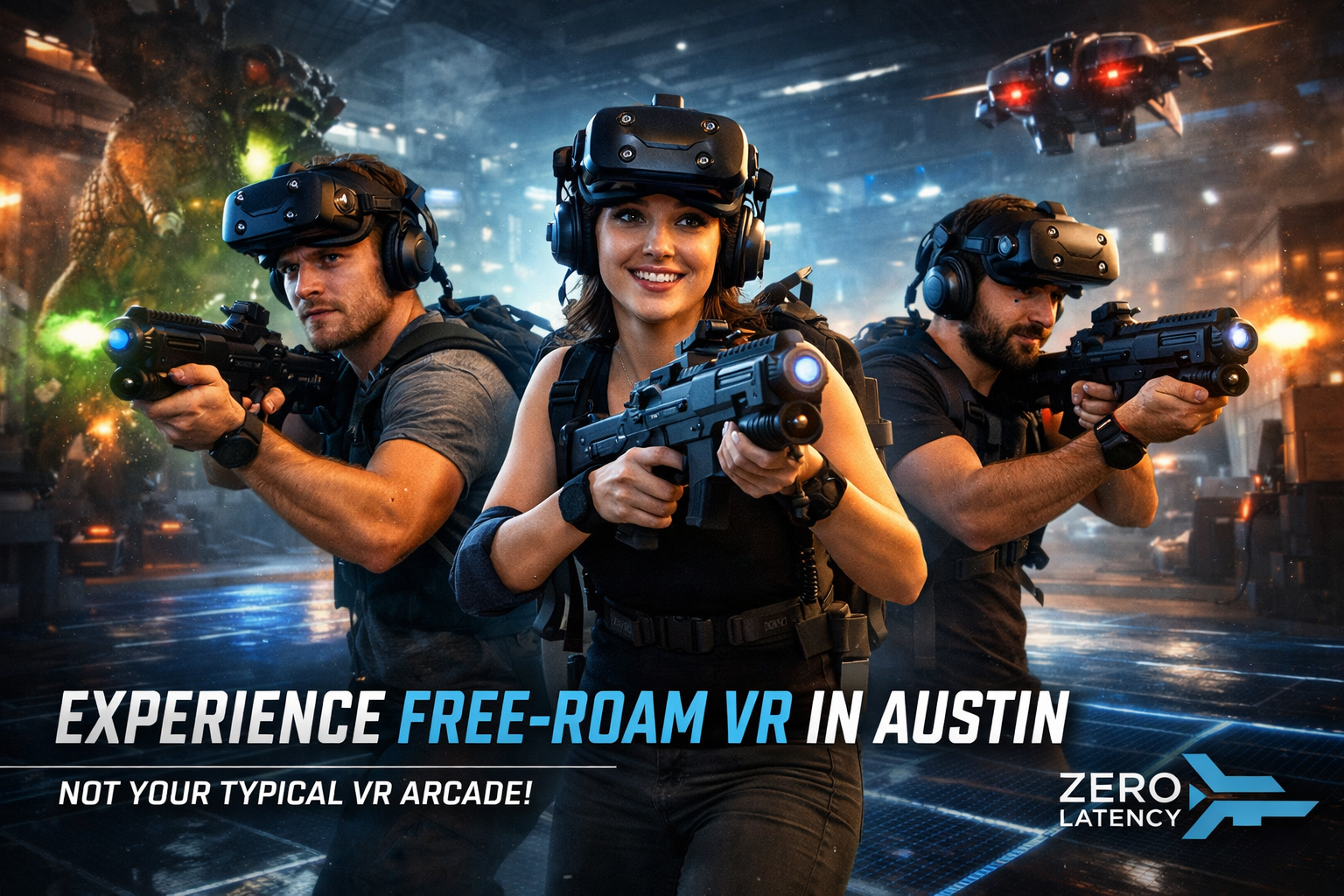
When people search for VR Austin, virtual reality Austin, or even just fun indoor activities in Austin, they are often using one phrase to describe several completely different kinds of experiences. That is part of why so many first-time players show up with one set of expectations and leave surprised by how different the real thing feels.
For a lot of people, the phrase "VR arcade" still brings a very specific image to mind: a row of stations, a headset, maybe a pair of hand controllers, and a game that mostly happens in one place. That version of virtual reality can absolutely be fun. But it is not the only kind of VR experience — and it is not necessarily the kind that creates the strongest group memories.
Free-roam virtual reality changes the equation. Instead of standing in a small square, facing one direction, and interacting with the world mainly through your hands, you and your group physically move through a shared space. You walk. You turn corners. You react to teammates in real time. You naturally duck, regroup, point, scatter, and chase. The result feels less like sampling a piece of technology and more like stepping into an event.
At Zero Latency South Austin, that full-body, multiplayer structure is the point. So what actually makes free-roam VR different from a typical VR arcade experience? The answer is not just one feature. It is a stack of design choices that change the way people move, react, connect, and remember the experience afterward.
The phrase "VR arcade" covers a lot more than people realize
Casual search language tends to flatten everything into the same category. Someone types "VR arcade Austin" into Google, clicks a few results, and assumes every option is basically a variation on the same format. In reality, there can be a huge difference between a headset attraction built around a small player box and a free-roam venue built for large-scale movement.
Traditional VR arcade setups often rely on a compact tracking area. The player remains in one station or one limited footprint while the virtual world does most of the moving around them. That can work well for rhythm games, short demos, cockpit simulations, or single-player experiences meant to be sampled in quick sessions. The strength of that model is convenience — it lets a lot of different games rotate through the same physical setup.
But the limitation is built into the format. If your body is mostly staying put, part of your brain never fully forgets where you really are. You know you are standing in a booth, on a marked square, or within a boundary you should not cross. Even when the visuals are impressive, your movement options quietly remind you that you are still operating around a constraint.
Free-roam VR lets your whole body participate
The simplest way to explain the difference is this: free-roam VR asks your whole body to join the experience.
That sounds obvious, but it changes everything. In many standard VR formats, your body exists mainly as a support system for your eyes and hands. You look around. You aim. You press buttons. Maybe you pivot or sidestep a little. The interaction can still be immersive, but much of the experience is filtered through inputs rather than full movement.
In free-roam VR, movement itself becomes part of the language of play. Players begin making decisions with their feet, their spacing, and their positioning. They naturally spread out, close gaps, rotate formation, or retreat toward one another. Even people who do not think of themselves as "gamers" understand those instincts immediately — because they are rooted in real-world physical behavior.
Fear lands harder
When your body is the thing retreating, the adrenaline spike is real — not simulated.
Victory feels collective
When the team literally advances together, the win belongs to everyone.
Lower learning curve
Your body already knows how to move. The headset just gives those instincts a new world to operate inside.
It is the same reason people often describe free-roam VR as more like an attraction, an adventure, or an event than a game station. The physical participation makes the experience feel lived rather than observed. Even when players laugh at themselves afterward, they are usually laughing about what they did, not just what they watched happen.
Shared space changes the social energy
Another major difference between free-roam VR and a typical VR arcade setup is the social dynamic.
A lot of entertainment options are technically group activities, but they do not always feel collective in the moment. People can be in the same room while still operating in parallel — each person has their own station, their own screen, their own score, and their own experience. They may compare notes afterward, but during the activity they are functionally separate.
Free-roam VR creates a stronger sense of being in it together. Because the group is physically moving through the same mapped environment, teammates feel present in a way that is immediate and intuitive. You are not just hearing a voice on a headset. You are seeing where your group is bunching up, who is charging ahead, who is hanging back, who panics first, and who suddenly becomes the unlikely hero of the session.
"The memory belongs to the group rather than a single high-scorer. People do not just say, 'I tried VR.' They say, 'We did this insane thing together, and you have to come do it with us.'"
This matters especially for mixed groups. Every group has different comfort levels with games, competition, and technology. Some people love leaderboards. Some hate them. Some want strategy. Some just want to have fun without feeling judged. Free-roam VR tends to cut through those barriers because the strongest moments are not only about individual skill — they are about reactions, communication, and shared momentum.
That is why a group can walk out talking about one person's heroic save, another person's terrible callout, or the exact second everyone lost their nerve and bolted. Those are not just game beats. They are shared stories that belong to the whole group.
Ready to see the difference for yourself?
Book a Session at Zero LatencyWhy the format fits Austin so well
Austin is a city that values experiences. People here are always looking for something that feels worth leaving the house for, worth inviting friends to, and worth talking about later. That means the bar is higher than "it was fine." For an outing to stand out, it usually needs to feel active, social, and a little different from the default options.
That is part of why free-roam VR fits so naturally into the local entertainment mix. It is indoors — which matters in a city where the weather can push people off outdoor plans fast. It works for groups — which matters in a city with a strong culture of birthdays, meetups, double dates, work socials, and reunion-style hangouts. And it feels modern in a way that lines up with Austin's identity as a city that values innovation and experience.
When people search for indoor activities Austin, they are often not just looking for shelter from the weather. They are looking for something that still feels like a real plan. They want the backup option that does not feel like a backup.
Free-roam VR solves that problem well because it still feels event-sized. You are not simply killing time indoors. You are stepping into an attraction that has energy, structure, and payoff. That makes it particularly strong for groups trying to choose one activity everyone can get excited about — even the skeptics.
Who free-roam VR is best for
One of the biggest misconceptions about virtual reality is that it only appeals to a narrow slice of people. In practice, free-roam VR tends to work for a much broader audience than many first-timers expect.
That said, the format especially shines when the goal is not passive entertainment. Free-roam VR is at its best when people want to participate — the laughs, the tension, the scramble, the triumph, and the stories. They want the kind of outing that gives everyone a role, even if that role is "the friend who screamed first and never recovered."
What first-time players should know before they go
For people who have never tried a free-roam experience before, the best advice is simple: do not overthink the technology. You do not need to show up as an expert. Most first-time players adapt faster than they expect because the experience is built around natural movement and team interaction.
The key is to treat it less like a tech demo and more like stepping into a scenario. Once people make that mental shift, everything tends to work better. They stop worrying about "doing VR right" and start responding to the world in front of them. That is when the real fun begins.
Why people remember it afterward
Ultimately, the biggest difference between free-roam VR and a typical VR arcade experience is not a spec sheet. It is the kind of memory each one creates.
People remember free-roam VR the way they remember a live experience. They remember how their group moved, where the panic started, who yelled what, who tried to be brave, and which split-second choices turned into running jokes on the drive home. The memory has shape because the experience had physical presence.
That is a powerful advantage in a crowded entertainment market. People have more choices than ever when they are looking for things to do in Austin. If an outing is going to stand out, it needs to create something stronger than "we passed the time." It needs to generate a real story.
That is what free-roam VR does well. It turns technology into a setting for shared experience. It makes groups feel active rather than passive, connected rather than separate, and immersed rather than merely impressed. And because of that, it often changes the way people think about virtual reality altogether.
For anyone still comparing all VR options as if they are basically the same, it helps to understand that the format itself changes the feeling. Free-roam VR is different because it asks more from the body, gives more to the group, and leaves behind a stronger kind of memory. If you are searching for virtual reality in Austin and want something that feels closer to an event than a booth demo, that difference is exactly what makes it worth trying.
Not Just a VR Arcade — An Actual Event
At Zero Latency South Austin, stepping into a fully immersive free-roam experience with friends, coworkers, or family is not just about wearing a headset. It is about stepping into a shared world with your group and coming back out with the kind of story people immediately want to tell someone else.