
How Free-Roam VR Works: The Tech Behind Arena-Scale Virtual Reality in Austin
A behind-the-scenes guide to tracking, networking, safety, and why it feels so real at Zero Latency VR – Austin
Ready to Experience Free-Roam VR?
Introduction
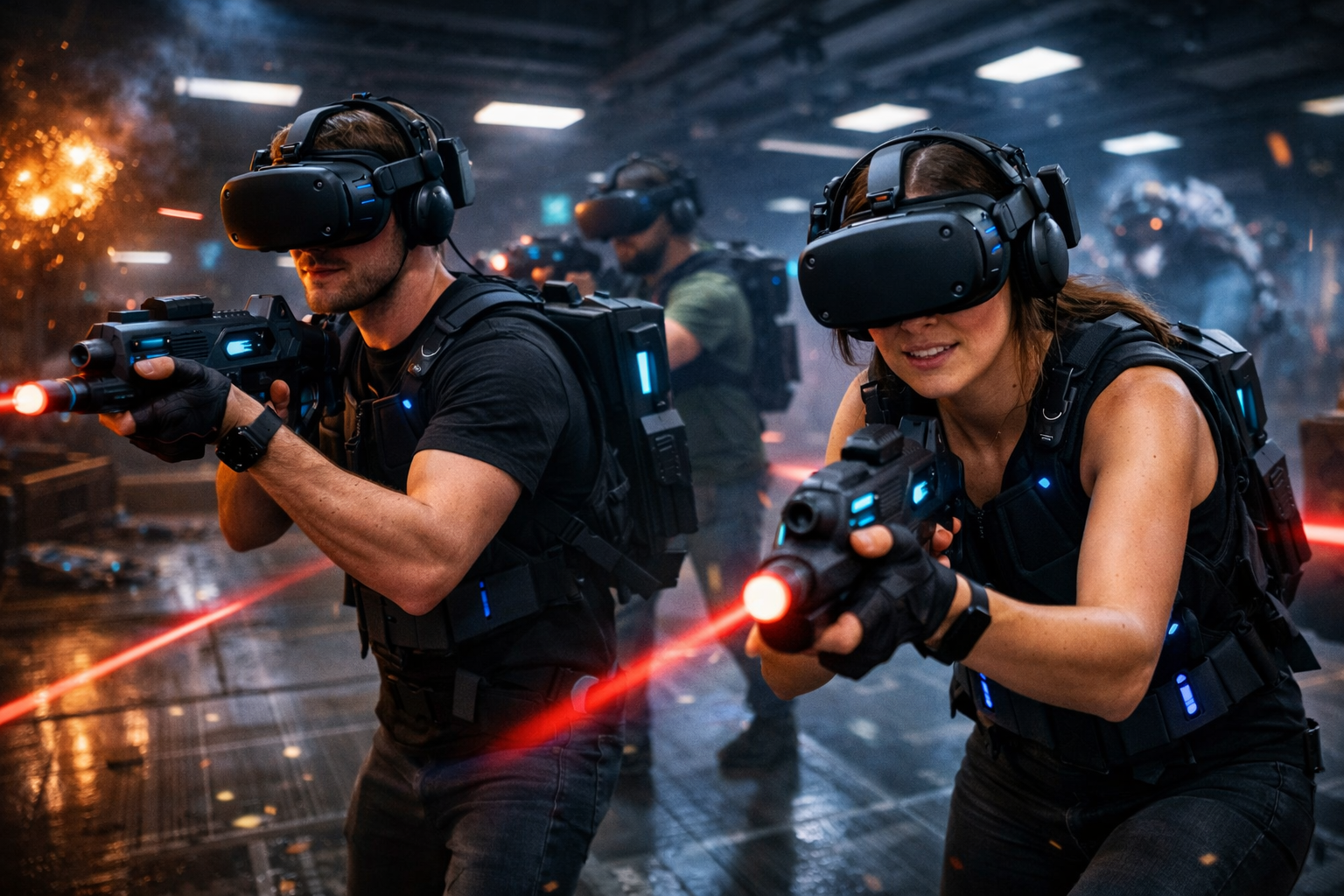
When people hear "virtual reality," they often imagine standing still in a living room, waving controllers at floating menus. Free-roam VR (also called arena-scale or location-based VR) is different: you walk, duck, peek around corners, and cooperate with teammates in a shared space that matches the real room you're moving through. That physical movement is the secret sauce - and it's also the hardest part to pull off reliably.
In this guide, we'll break down the technology and design decisions that make free-roam VR feel so convincing. You'll get a clear explanation of how tracking works, why latency matters, how multiple players stay synchronized, and how venues engineer safety so you can move fast without worrying. If you've ever wondered what's happening "under the hood" at a VR arena like Zero Latency VR in Austin, this is the deep dive.
What "Free-Roam VR" Actually Means
Free-roam VR is a category of immersive entertainment where players physically move through a dedicated play area while wearing VR headsets. Unlike traditional "seated VR" (where you remain in one spot) or "room-scale VR" (where you can move within a small living-room-sized boundary), free-roam experiences are designed around a much larger arena - often thousands of square feet - so you can explore, reposition, and coordinate like you would in a real environment.
Most free-roam venues are part of what the industry calls "location-based entertainment" (LBE), which includes attractions built specifically for out-of-home experiences. That matters because an LBE venue can do things you typically can't do at home: manage dedicated networking, control lighting and space layout, calibrate equipment between sessions, and provide staff oversight for smooth onboarding and safety.
If you want a good high-level overview of this category, the Location Based Entertainment Association (LBEA) provides context on the broader LBE industry, and Wikipedia's entry on location-based virtual reality is a handy quick definition.
The Big Challenge: Knowing Exactly Where You Are
To feel real, a VR system must know your position and orientation in space constantly. In a free-roam arena, "close enough" isn't close enough - if the system thinks you're 6 inches to the left of where you really are, your brain notices. That mismatch can cause everything from slight unease to motion discomfort.
Modern headsets use one of two broad tracking approaches:
Outside-in tracking: external sensors (like cameras or base stations) track the headset and controllers from the outside.
Inside-out tracking: sensors on the headset look outward and use computer vision to calculate your movement through the space.
Many newer standalone headsets rely on inside-out tracking because it's flexible and easier to deploy at scale. Inside-out tracking typically uses simultaneous localization and mapping (SLAM) - the headset builds a map of visual features in the room and continuously estimates its own motion relative to those features.
If you're curious about the computer vision concept, SLAM is well-documented in robotics and AR/VR research.
Mapping the Arena: Calibration and Spatial Anchors
Even with strong tracking, an arena still needs calibration so the virtual world lines up with the real one. That's where "spatial anchors" come in: reference points that help the system understand the arena's geometry and keep players aligned session after session.
A venue typically goes through a calibration process that defines:
The playable boundaries (where walls are in the real world)
Safe zones and staff zones
Entry/exit paths so groups can load in without crossing streams
Any physical props (like a doorway, railing, or marker) that should match a virtual object
Calibration isn't glamorous, but it's a major reason free-roam experiences feel consistent. It also makes content design possible - game designers can assume the room exists in a known configuration, so they can place objectives, cover, and chokepoints with intention.
Why Latency Matters More Than You Think
Latency is the delay between your real movement and what you see in the headset. Your brain is incredibly sensitive to this. High latency makes turning your head feel "swimmy," throws off aiming, and can increase discomfort. In a multiplayer arena, latency also affects fairness - if two players see the same moment differently, coordination breaks down.
A well-designed free-roam system optimizes multiple parts of the pipeline:
Sensor capture — tracking computation
Rendering — drawing the scene
Networking — syncing players and events
Display response — how quickly the headset panel updates
Many VR platforms target very high frame rates (often 90Hz or higher) because smoother updates reduce perceived delay. For a technical perspective on VR performance and motion-to-photon latency, NVIDIA and other hardware vendors have published accessible explanations over the years.
Multiplayer Synchronization: How Everyone Shares One Reality
Free-roam VR is at its best when your group truly shares the same world. That requires constant synchronization:
Each player's position and orientation
Projectile and interaction events (shots, reloads, button presses)
AI behavior (enemy movement and spawns)
Match state (objectives, timers, scoring)
Most arena systems use a local network architecture to keep latency low. Instead of routing critical gameplay data across the public internet, the venue runs servers on-site (or on a tightly managed network) so player updates arrive in milliseconds, not hundreds of milliseconds.
Under the hood, the software is making tradeoffs all the time: it may predict motion between updates, smooth out jitter, and reconcile differences so the simulation stays stable. If you've ever played online competitive games, you've experienced versions of these techniques. In a VR arena, the stakes are higher because your body is physically moving.
Open Standards and Compatibility: Why OpenXR Matters
You don't need to be a developer to appreciate why open standards are important. In VR, the major idea is: the same game can support multiple headset types without being rewritten for each hardware platform. That's where OpenXR comes in - a royalty-free standard from the Khronos Group that defines common APIs for VR and AR.
When games and platforms align around OpenXR, it becomes easier to maintain experiences across changing hardware generations. For venues, that can mean faster updates, smoother deployments, and fewer "one-off" compatibility headaches.
If you want to read the standard's goals straight from the source, Khronos maintains OpenXR documentation and explanations on their site.
Designing for Safety Without Breaking Immersion
The #1 fear first-timers have is "What if I run into something?" A good free-roam venue designs around that concern in layers:
1) Physical environment design
The arena is kept clear, with consistent flooring, controlled lighting, and predictable paths. Staff also manage group flow so players enter and exit safely.
2) Digital boundary systems
Most VR platforms can display a boundary (sometimes called a "guardian" system) when you approach the edge of the play area. It's like a subtle heads-up display that says, "Hey - wall nearby." The goal isn't to remind you you're in a room; it's to prevent collisions before they happen.
3) Onboarding and coaching
A strong pre-game briefing changes everything. Players learn how to move safely, how to keep awareness of teammates, and what to do if something feels off. Clear instructions reduce anxiety and let people lean into the fun.
If you've used Meta Quest headsets at home, you've seen a consumer version of boundary systems. The same concept scales up in professional venues with more controlled calibration and oversight. Learn more about Meta Quest boundary/guardian systems.
Comfort Engineering: Why Free-Roam Can Feel Better Than At-Home VR
Here's a surprising truth: for many people, free-roam VR can feel more comfortable than stationary "stick movement" VR. Why? Because walking is a motion your brain expects. When your legs move, your inner ear and your vision agree that you're changing position. That agreement can reduce the sensory mismatch that sometimes causes VR discomfort.
Venues also tune experiences for comfort:
Movement design that favors real walking over artificial locomotion
Session lengths that are intense but time-boxed
Staff pacing between rounds so you can reset
Reliable framerates and clean tracking
This doesn't mean everyone will feel identical - comfort varies by person - but it's one reason free-roam VR is often a great "first VR" experience.
Audio, Haptics, and the Little Details That Sell the Illusion
Visuals get the headline, but immersion comes from the whole package.
Spatial audio helps your brain locate threats and teammates. If you hear footsteps behind you and the sound actually tracks correctly as you turn, it feels real. Many VR systems use head-related transfer functions (HRTFs) to simulate how sound waves interact with the human head and ears. If you want to geek out, the concept is widely explained in audio engineering resources.
Haptics are the second piece. Even simple controller vibration can add weight to actions like reloading, striking, or taking damage. Some venues go further with physical props and environmental effects, but even baseline haptics dramatically improve "presence" - that sensation of being in the world.
Unity and Unreal Engine are common game engines used in VR development because they support real-time rendering and wide platform integration. Their VR documentation gives a sense of the toolchains involved: Unity XR documentation and Unreal Engine XR documentation.
From Blueprint to Battlefield: How Designers Build an Arena-Scale Game
Making an arena-scale game isn't just "make a VR shooter, but bigger." Designers build around the reality that players are physically walking, sharing space, and managing real-world fatigue.
Arena-scale design often emphasizes:
Clear roles (support, damage, objective runner) so teams coordinate naturally
Readable objectives (you always know what to do next)
Smart pacing (burst intensity, then short breathing windows)
Social moments (revives, callouts, celebrating a clutch win)
Replayability (randomized spawns, difficulty scaling, score chasing)
You'll also notice that free-roam games usually have strong "chunking" - missions are broken into digestible segments. That keeps sessions exciting without becoming overwhelming, and it makes it easier for staff to reset groups between matches.
Why It's So Social: Presence, Body Language, and Shared Space
One reason groups love free-roam VR is that it's genuinely social. Even though you're wearing a headset, you're still moving your body in the same room as friends or coworkers. You can see teammates gesture, point, and turn - and your brain reads those cues like it does in real life.
Psychologists and VR researchers often talk about "presence" and "co-presence" - the feeling that you are in a place, and that other people are there with you. Free-roam setups strengthen both because your movements are natural and synchronized.
If you're interested in the research side, the IEEE and ACM have published many papers on VR presence over the years. A simple starting point is the Wikipedia overview of presence in virtual reality.
Final Thoughts: Why Free-Roam VR Feels Like the Future
Free-roam VR combines cutting-edge tracking, low-latency networking, thoughtful safety design, and careful game development to create experiences that simply aren't possible at home. When all these systems work together, you stop thinking about the technology and start living in the world.
That's why venues like Zero Latency VR in Austin exist - to give you access to the best hardware, the largest play spaces, and the most polished multiplayer experiences available. Whether you're fighting zombies, competing in team battles, or exploring alien landscapes, you're doing it with your whole body, alongside real people, in a shared reality that feels completely convincing.
Ready to Step Into the Arena?
Now that you know how it all works, it's time to experience it for yourself. Book your session at Zero Latency VR Austin and feel what arena-scale virtual reality is really like.